Can’t stop crying over your ex? Why it happens, 9 practical steps, a 5-minute reset for tonight, and when the crying usually starts to ease.
Focus on small actions—limit contact, name the emotions, shift routines, and reach out for support—to stop daily crying and begin healing.

Why can't I stop crying over my ex?
You can't stop crying because your brain is still attached to someone who is no longer there. A close relationship becomes part of your daily wiring. Their texts, their voice, your plans together all became signals your brain expected.
When those signals stop, your brain keeps reaching for them. Researchers who scanned people recently rejected in love found activity in the same reward and craving areas linked to withdrawal. That's why heartbreak can feel physical, and why the crying comes back in waves.
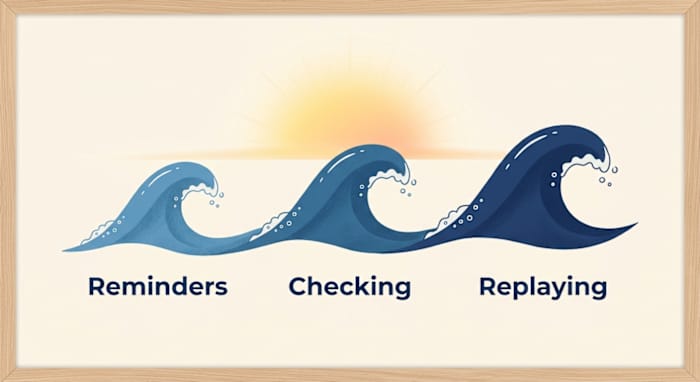
Three things keep the waves coming:
- Reminders. A song, a place, a photo, a time of day restarts the craving.
- Checking. Looking at their social media reopens the wound every time.
- Replaying. Going over what you should have said keeps your brain in the relationship.
The steps below work on all three.
How to stop crying over your ex: 9 practical steps
1. Give the crying a set time
Pick 15 minutes a day, same time, to let it all out. Cry, write, play the sad song. When the urge hits outside that window, tell yourself "not now, at 8." This isn't suppressing. It's giving your grief a container so it stops running your whole day.
2. Find your triggers
For three days, note every time the crying starts and what came just before. Most triggers fall into three groups:
- Sensory: a song, a smell, their handwriting
- Situational: your old Friday night routine, a shared coffee shop
- Dates: anniversaries, birthdays, the day of the week you used to talk
Pick one trigger this week and remove or change it. Move the photos to a folder. Change the playlist. Take a different route.
3. Go no contact, and mean it
Every text, call, or profile check restarts the craving. Commit to 30 days with no contact. Mute or archive them on every app, so they can't appear in your feed by accident. If you share children or work, keep contact short, written, and about logistics only.
4. Separate facts from stories

Take a page and draw a line down the middle. On the left, write what actually happened. On the right, write the story you're telling yourself about it.
- What happened
- The story I'm telling myself
They ended the relationship. | No one will ever love me again.
They posted a photo with friends. | They're already over me and happy.
Then write a fairer version of each story. Do this for one week. Crying shrinks when the story behind it gets smaller.
5. Use 90 seconds of self-compassion
Put a hand on your chest. Say quietly: "This hurts. Heartbreak is part of being human. I can be kind to myself right now." Shame keeps crying going. Kindness lets it pass.
6. Wait 24 hours before you text them
When the urge to message them hits, write the message somewhere they'll never see it: a notes app, a journal, an unsent letter. Wait 24 hours. Most of the time, the urge is gone by morning, and you'll be glad you didn't send it.
7. Protect your sleep, food, and movement
Crying gets worse when your body is running on empty.
- Sleep: same bedtime every night, phone out of the bedroom
- Food: small regular meals, even when you're not hungry
- Movement: a 10-minute walk outside, every day
8. Talk to one person every day
Isolation turns sadness into a loop. Text, call, or see one friend or family member each day. You don't have to talk about the breakup. You just need to be around someone who's on your side.
9. Rebuild one thing that's only yours
Pick one thing your relationship pushed aside: a hobby, a goal, a friendship, a fitness habit. Give it 20 minutes a few times a week. This is where crying starts to turn into rebuilding. If you want a step-by-step plan for this part, it's the focus of my book How To Be Confident After A Breakup.
What to do tonight.
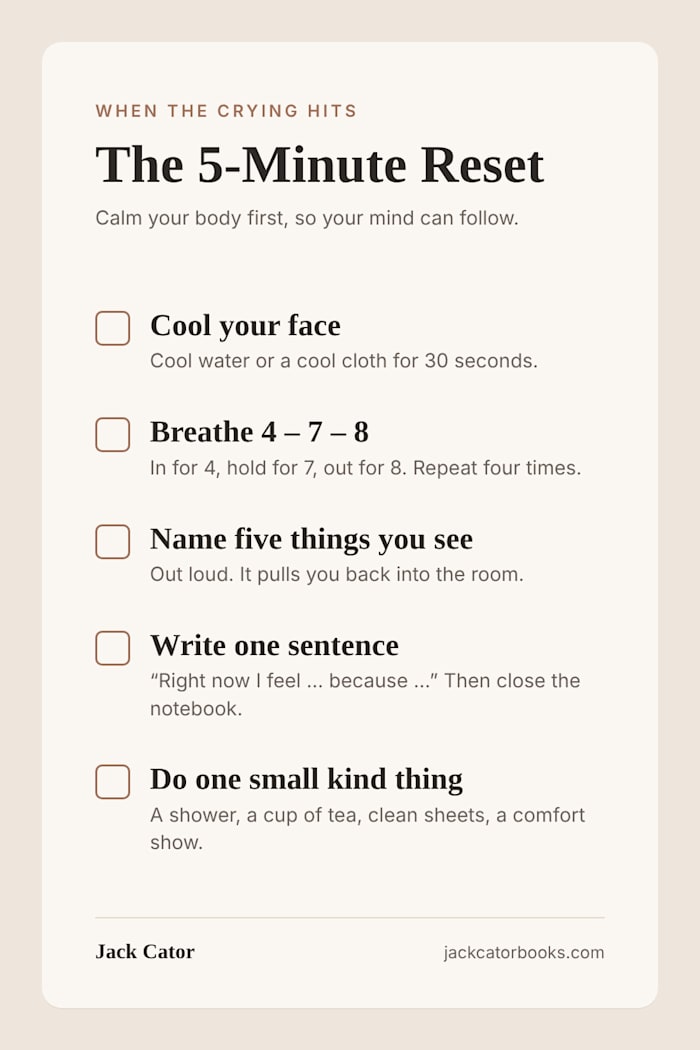
This 5-minute reset calms your body first, so your mind can follow.
- Cool your face. Splash cool water on your face or hold a cool cloth to it for 30 seconds. It helps slow your heart rate.
- Breathe slower than you feel. Breathe in for 4, hold for 7, breathe out for 8. Repeat four times.
- Name five things you can see. Say them out loud. It pulls your attention back into the room.
- Write one sentence. "Right now I feel … because …" Then close the notebook.
- Do one small kind thing. A shower, a cup of tea, clean sheets, a comfort show.
If you still feel the pull to text them, go back to step 6 above and write the message you won't send.
When will I stop crying over my ex?
There's no fixed date, but there is a usual pattern. The crying rarely stops all at once. It gets less frequent, then shorter, then easier to recover from.
- The first days to weeks: crying can come many times a day, often without warning.
- The next several weeks: it becomes tied to specific triggers, and you get stretches of feeling okay.
- Over the following months: it mostly shows up around anniversaries, songs, or news about them, and passes faster.
How long it takes depends on how long you were together, how the relationship ended, and whether you're still in contact. No contact and steady routines (steps 3 and 7) usually shorten it the most.
A bad day after a good week isn't going backwards. It's what healing in waves looks like.
When crying is a sign to get more support
Heartbreak is painful, but it shouldn't take over your whole life for months. Talk to a doctor, therapist, or counselor if:
- You've cried most of the day, nearly every day, for more than two weeks
- You can't sleep, eat, work, or look after yourself or your kids
- You feel hopeless, numb, or like nothing will get better
- You're drinking or using something to get through the day
Reaching out isn't weakness. It's the fastest way back to yourself.
If you ever have thoughts of harming yourself, reach out now. In the US, call or text 988 (Suicide & Crisis Lifeline). In the UK and Ireland, call Samaritans at 116 123. If you're somewhere else, contact your local emergency number.
Frequently asked questions
Is it normal to cry every day after a breakup?
Yes, especially in the first few weeks. Daily crying is a normal grief response. It becomes a concern if it lasts more than two weeks without easing, or stops you from functioning.
Why do I still cry over my ex months later?
Usually because something is still reopening the wound: contact, checking their social media, or a strong reminder. Crying months later often comes in short waves around triggers, and that's normal too.
How do I stop crying over someone I still love?
Stop trying to stop the love first. Focus on the crying: give it a set time each day, cut contact, and replace the replaying with journaling. The feelings fade faster once they're not being fed.
Why can't I stop crying when I see my ex on social media?
Every photo is a fresh reminder of what you lost, and of a life that's moving on without you. Mute or archive them on every platform. It's not petty, it's protecting your healing.
Is crying over my ex a sign I should get back together?
Not by itself. Crying means you lost something important, not that the relationship was right. Make that decision on a calm day, not in the middle of a wave.
Can crying too much be harmful?
Crying itself isn't harmful, and it often brings relief. If it comes with not sleeping, not eating, or feeling hopeless for weeks, that's a sign to talk to a professional.
You aren't broken. You're rebuilding.
The crying won't disappear overnight, and it doesn't have to. Each day you follow even two or three of these steps, the waves get smaller and further apart.
Start with one thing today: set your 15-minute crying window, or mute their profiles. That's enough for now.
Free: the Breakup Recovery Starter Kit. A 7-day plan, a no-contact checklist, and an urge-control worksheet to get you through the hardest first week. Get the free kit
Ready for the next step? When the crying eases, the real work is rebuilding your confidence. How To Be Confident After A Breakup walks you through it step by step, in paperback, ebook, and audiobook.
Keep reading: Proven ways to stop thinking about your ex · Does the no contact rule really work?
For a full No Contact Checklist (including digital boundaries), scroll to Section 4 or download the free kit.
Ready for a structured plan? How to Be Confident After a Breakup gives you a 4-phase recovery system. Available on Amazon and Payhip.
Why it works: Cold water triggers the dive reflex, lowering heart rate and overriding the urge to cry. Combined with paced breathing, it physically interrupts the crying loop.
Use this anytime you feel tears building. It won’t solve the root cause – but it gives you control in the moment.
Need a structured recovery plan?
Download the free Breakup Recovery Starter Kit.
👉 Get the full printable No Contact Checklist in the Breakup Recovery Starter Kit – includes daily tracking and urge control logs.
✅ You've stopped the crying for now.
That's huge. Ready to rebuild the confidence your ex never deserved to see disappear?
How To Be Confident After A Breakup 4.8 STARS Rating
The kit helps you survive the breakup.
The audiobook helps you rebuild yourself afterward.
Get both – start with the sample
NEXT: Ready to Rebuild Your Confidence After the Breakup?
You’ve stopped the spiral.
Get:Think Positive, Live Positive
Feeling stuck in self-doubt? Wish you could quiet that inner critic and finally go after what you really want?
Think Positive, Live Positive is a straightforward, no-fluff guide to rewiring your mindset, managing stress, and creating the life you’ve always imagined.
Now it’s time to rebuild your confidence, self-worth, and emotional strength.

Think Positive, Live Positive
⭐ Rated 4.7 by listeners in the UK.
✔ Rebuild confidence
✔ Stop overthinking
✔ Heal emotional wounds
✔ Feel like yourself again
👉 Listen to the free sample now
START REBUILDING TODAY — FREE
📥 Get the free Breakup Recovery Starter Kit (7-day plan, identity work, no-contact tracker) → jackcatorbooks.com
🎧 Want to go deeper? The audiobook "How to Be Confident After a Breakup" picks up right where the kit leaves off — like a close friend walking you from surviving to thriving.
👉 Listen to the free sample (4.8★) → 🎧 Listen to it: Audible
Like this post? Join 5,000+ readers who get weekly insights on love, loss, and real healing. 👉 Subscribe for free via email
You’ve taken the first step by reading this far. Now take the next one – grab the kit, start Day 1, and watch the crying lose its power over you.
You’ve got this. 💪
How to Get Over a Breakup (What Actually Works) #breakupadvice